A personal blog by Ackworth born Gerald England who married a Lancashire lass, went West and now lives in Cheshire.
Showing posts with label Wales. Show all posts
Wednesday, July 13, 2016
ABC Wednesday: A is for Andy Pearce
On the evening before the start of the annual Victorian Extravaganza Weekend, the lifeboat "Andy Pearce" was towed onto the slipway where it remained for the whole weekend. The Mersey class "Andy Pearce 12-006" arrived at Llandudno on 15th November, 1990 and after a week of intensive crew training, she was placed 'on station' on 23rd November. It is capable of operating at up to 17 knots (31 km/h) and can be launched from a carriage but can also lie afloat or be slipway launched when required. Its propellers are fully protected from damage when launching or in shallow water by partial tunnels and two bilge keels. Its low height can be further reduced by collapsing its mast and aerials which then allows it to be stored in a boathouse. A sealed cabin gives it a self-righting ability. Power comes from two Caterpillar 285hp turbo-charged engines. It carries 1,110 litres (290 US gal) of fuel to give it a range of 240 nautical miles (440 km). It has a crew of six and can carry a X Boat inflatable which it can deploy at sea. Its survivor compartment can carry 43 people, but more than 21 prevents self-righting should the boat capsize.
The All-weather Lifeboat 'Andy Pearce' cost approximately £455,000.00 to build and was provided out of a legacy from Mr Andrew Pearce, plus other gifts and legacies. Andy Pearce successfully carried out her first rescue on 17th April 1991 when she was launched in early darkness to rescue two men in difficulties off the Rhos-on-Sea breakwater. The two men, in a 25' converted ships lifeboat, had been in trouble at the boat's mooring because of a strong north westerly wind (more than 40 mph) and a four foot swell. Both men were taken abroad the lifeboat unharmed and landed safely at Deganwy.
After use the lifeboat is towed back through town to the lifeboat station. Llandudno Lifeboat Station is the only lifeboat station in the UK to have its boathouse located in the middle of town. Whereas most lifeboat stations are situated next to the sea for obvious reasons, Llandudno Lifeboat Station is situated in Lloyd Street, almost equidistant from both of Llandudno's shores. The reason for this unique situation goes back to 1861 when the boathouse was positioned so that the boat could be towed equally quickly to either North Shore or West Shore.
The current boathouse was constructed in 1903. A new lifeboat station is currently being built at Craig-y-Don where a larger boat can be accomodated.
For more information visit the lifeboat website.
A contribution to ABC Wednesday.
Wednesday, June 29, 2016
ABC Wednesday:
Y is for Ynys Gored Goch
Ynys Gored Goch (Red Weir Island) also known as Whitebait Island sits in the Menai Strait between the two bridges that link Ynys Môn (Anglesey) to the mainland. The stretch of water is known as "The Swellies" due to whirlpools formed by the string tidal flow.
In 1590 the island belonged to the Diocese of Bangor who leased the island to Thomas Fletcher of Treborth who paid three pounds plus one barell full of herring. The island was used as a fishing trap. During high tides fish would swim into traps set near the island.
In the early 20th century, it was fashionable for visitors to cross to the island to enjoy whitebait teas. They would walk down to the shore by a footpath through the Coed Môr woods, ring a bell placed on the shore for the purpose, and a boat would put out from the island to collect them. The Gorad Whitebait Tea consisted of a pot of tea, brown bread and butter, and whitebait "fried in a basket", priced one shilling. During very high tides in the spring and autumn, the water sometimes reaches the outside of the houses on the front and west sides.
In more recent times the island has been privately owned and according to the details on the Wales Directory the two houses on the island are available for use as holiday accomodation, although this information may not be current.
Information sources:
Anglesey Today;
Wikipedia;
Anglesy Hidden Gems.
A contribution to ABC Wednesday and Wednesday Waters.
Saturday, June 04, 2016
Kashmir Goat sculpture on the Great Orme
The Shah of Persia gave a herd of Kashmir goats to Queen Victoria who passed them on to Lord Mostyn the local landowner in Llandudno and their descendants now roam the Great Orme. I posted photos of a black goat at West Shore in a post dated 2nd August 2014. A fuller account of the goats can be found on the Visit Wales website.
This sculpture was unveiled in 2002 at the opening of the refurbished Great Orme Visitor Centre next to Summit Tram Station. It wasn't until I tried to find more information about the sculpture that I discovered it was by Graham High, the same Graham High whose fourth poetry collection Wolf on the Third Floor I published in 2000.
For more information on his work in various creative fields please visit Graham High's website.
The coloured version of this photograph can be found on Geograph.
A contribution to
The Weekend in Black and White;
Weekend Reflections;
Shadow Shot Sunday.
Wednesday, May 25, 2016
ABC Wednesday:
T is for Tombola

Tombolo (BF6303) is a Foden steam traction engine built in 1911.
It was taking part in a parade during the 30th Llandudno Victorian Extravaganza Weekend.

The Llandudno Victorian Extravaganza was founded in 1986. It is staged on the town centre streets, each May Day Bank Holiday. The Llandudno Transport Festival is a sister event on Bodafon Fields run by local transport enthusiasts.
Many more of the photographs I took of the weekend can be viewed on Geograph.
A contribution to ABC Wednesday.
Wednesday, May 18, 2016
ABC Wednesday:S is for Surf Snowdonia
Surf Snowdonia, opened in August 2015, as a brand-new artificial wave facility at Dolgarrog in the Conwy Valley, North Wales. Privately funded, it cost £12m to build, on the site of a former aluminium factory – though it has been decontaminated since, and approved by Welsh environmental regulators. It is the first in the world. Surf Snowdonia uses WaveGarden technology, pioneered by a group of surfer-engineers in San Sebastián, Spain, and which is being rolled out globally from Spring 2016. The waves are created once a minute by a snow plough-like weight that moves underwater along a central pier.
The attraction is 300 metres (985ft) long and 110 metres (360ft) wide (around the size of six football pitches) containing six million gallons of water with three wave heights offering waves that are up to six feet high if you ride the whole way of 150 metres. The pool is filled with rainwater collected from Snowdonia reservoirs including Llyn Cowlyd. This water passes through the adjacent hydro-power station, originally built to power the former aluminium plant, before being pumped from the tail-race into the surfing pool.
For further information see the Surf Snowdonia website.
A contribution to ABC Wednesday.
Wednesday, April 20, 2016
ABC Wednesday: O is for Ogofs below the Great Orme
Ogof is the Welsh word for cave. This is Ogof Colomennod one of several found in the Great Orme. Otherwise known as "Pigeons' Cave" it is found in Porth yr Helyg where a quarry was established to produce stone for the construction of Telford's Conwy Bridge and delivered by boat c1820. The wide limestone shelf is easily accessible and is a favourite location for sea angling. Still within Porth yr Helyg are features known as Frog's Head (a natural rock resemblance to a frog seen only from the sea) and Austen's Rock. The latter is a submerged limestone shelf named after the first keeper of Llandudno lighthouse who drew attention to this dangerous underwater feature that can only be seen at low tide.
Leftmost here is Ogof Pen Trwyn which is probably a sea cave and is only visible from the sea.
To the right of that is Ogof Haner Dydd (The Midday Cave). At 12 noon on the 21st March and the 21st September the sun shines directly into the mouth of the cave. It stretches 30m and is thought by some to be part of the Elephant Cave system.
More information on Caves of the Llandudno Area can be found on the Caves of North Wales site.
A contribution to ABC Wednesday and Wednesday Waters.
Saturday, April 09, 2016
Three Little Fishes
Lionfish (Pterois volitans) are covered in orange, brown, black and white stripes and have large feather-like spines at the ends of their fins which hide their venom tipped dorsal spines.
Found in the Indian and west Pacific oceans they feed on small fish, shrimps and crabs.
Longfin Bannerfish (Heniochus acuminatus) is a type of butterflyfish and can grow up to 25cm long. Its body is covered in white and black bands and it has bright yellow fins and tail.
Found in the tropical waters of the Indo Pacific and the Coasts of Africa, it feeds on zooplankton, small krill and other invertebrates and is known for eating the parasites off larger sea creatures.
Spotted Grunt (Plectorhincus chaetodonoides) is white with small brown spots along its body. They move to mimic a poisonous flat worm as a predatory response.
I discovered these last September on a visit to Rhyl SeaQuarium.
A contribution to Saturday Critters and Camera Critters.
Thursday, March 24, 2016
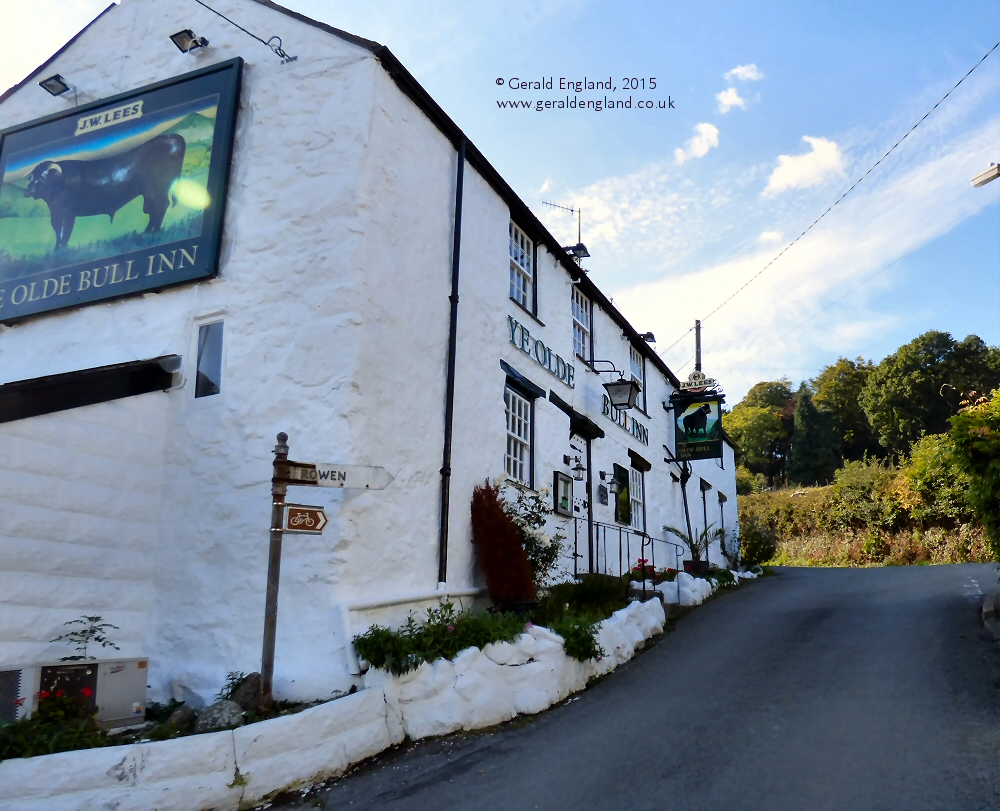
Ye Olde Bull Inn, Llanbedr-y-cennin
According to HistoryPoints this country pub dates from the late 17th century or early 18th. It may have replaced an even earlier hostelry on the site.
The road which climbs past it was used by drovers to take livestock from the mountains to markets further east. The name is thought to relate to the bullocks which hauled carts over the upland tracks. Some were kept at a farm a little further uphill from the pub.
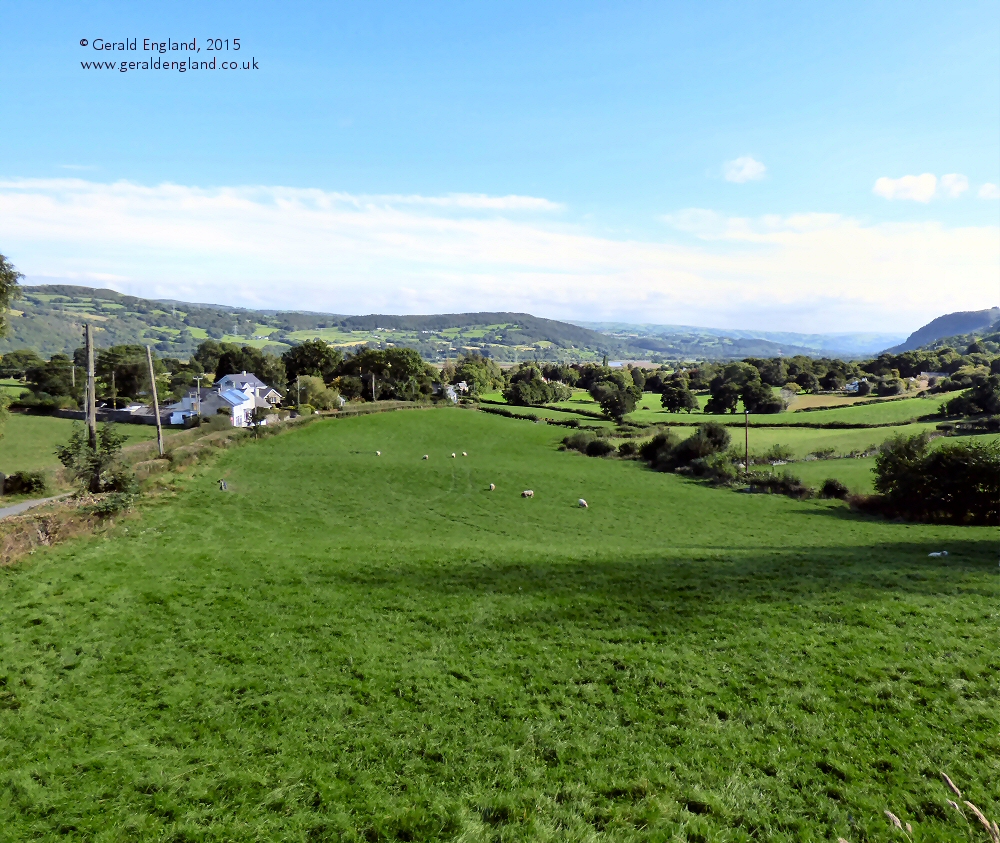
The fields behind the Bull Inn hosted annual sheepdog trials on New Year's Day. Competitors came from as far away as Cumbria and North Yorkshire, until entries grew so large that the competition was restricted, in 1905, to North Wales.
It is a J.W.Lees pub. For current information see its Facebook page.
A contribution to
signs, signs;
Skywatch Friday;
Scenic Weekends.
Sunday, March 13, 2016
St Hilary's Parish Church, Llanrhos
Access to St Hilary's Parish Church, Llanrhos is via a gated lych gate.
Llanrhos Church in Wales is dedicated to St. Hilary and is in the diocese of Saint Asaph. It is the oldest church in the parish of Llanrhos although the church was extensively rebuilt in 1865.
The practice of Christianity here goes back to the mid 6th Century as Maelgwn King of Gwynedd built the original church on this site. He is said to have later sought sanctuary in the church from the great yellow fever that was spreading throughout the country. He prostrated himself before the altar of the church and prayed for his life, but it was to no avail and he died a few days later.
The original church was replaced in about 1282, (one of the church's fonts dates from the Norman period) and although this medieval church was yet again replaced in the 19th Century it is believed that the Nave and Chancel walls were built by monks from the monastery at Maenan Abbey in the Conwy valley and that the present building incorporates the roof beams and several other features of the late medieval church.
The church was extensively restored between 1820 and 1865 with donations from the Mostyn family, the local landowners who lived at nearby Gloddaeth Hall . They still use the family burial plot in the churchyard. Inside the church, on the west wall, are memorials to the Wynne family of Plas Mawr, Conwy, into which the Mostyns married.
The church is surrounded on all sides by extensive burial grounds.
A guide to locating some of the more signifcant graves can be found on the HistoryPoints.org website.
Also known as SS Eleri & Mary it is one of seven churches in the Rectoral Benefice of Rhos-Cystennin in the Diocese of St Asaph. For current information visit the church website.
These photographs © Gerald England were taken on 16th September 2015.
A contribution to Shadow Shot Sunday and Inspired Sundays.
Thursday, March 10, 2016
Slate Fence at Cwm Penmachno
The fence posts alongside the road to Cwm Penmachno are made from slate
Slate was quarried at Cwm Penmachno from 1819 until 1962.
A contribution to Good Fences.
Sunday, March 06, 2016
Capel Salem, Penmachno
![]() |
| © Gerald England |
![]() |
| © Gerald England |
![]() |
| © Gerald England |
A contribution to Scenic Weekends and Inspired Sundays.
Sunday, February 14, 2016
The Virgin Mary And Saint Abaskhyroun, Llandudno
The Coptic Orthodox Church dedicated to The Virgin Mary And Saint Abaskhyroun was established in Llandudno in 2006. It uses the former Ebeneser Welsh Methodist Chapel on Trinity Avenue, which had been in use until 2003 by the Llandudno United Welsh Church.
The datestone indicates that the church was built in 1893 but I haven't been able to find any further details regarding its history.
As the notice indicates, it was consecrated as a Coptic Church on March 29th 2008 by His Holiness Pope Shenouda III, Pope of Alexandria and Patriarch of the See of Saint Mark and Overseas. Older foundation stones appear to have been whitened out.
It is one of only two Coptic churches in Wales. See Church website.
A contribution to Inspired Sundays.
Wednesday, December 16, 2015
ABC Wednesday:
W is for Wheelhouse
The Wheelhouse is a narrative show which unfolds inside and around a circular set as it rolls, with the audience walking alongside.
It is described as being "A gently comic dystopia, set in a different time where everything has a new value and survival relies on sharp eyes, quick hands, and, above all, friendship. Stunning design, theatrical acrobatics, and breathtaking moments of risk, all housed within an exquisite, hand-built structure."
It was commissioned as a walkabout by Without Walls in 2008 and funded for development into a full show (2011) by Applause. With Direction from Flick Ferdinando.
This flagship show by Acrojou has been seen in 13 countries and arrived in Llandudno in September 2015 as part of the Llandudno Arts Weekend LLAWN03.
More of my photos from LLAWN03 can be found on Geograph.
A contribution to ABC Wednesday.
Monday, December 07, 2015
Time Islands and Space Islands
Part of an exhibition, Time Islands and Space Islands by Diango Hernandez at
MOSTYN in Llandudno. It is the first solo exhibition, in a UK institution, by Cuban born and Düsseldorf-based artist, Diango Hernandez.
The show includes, amongst others, a site-specific wall mural entitled "A million people can be silent"; a series of fruit sculptures and reclaimed furniture; works on canvas and offset printed paper; and a fragile construction of rusted steel - a numerical representation of the years 1959 to 2008 in descending order.
The exhibition is on until 6th March 2016 - more details on the Gallery website.
A contribution to Monday Murals.
Saturday, December 05, 2015
A grey morning in Llandudno
Our weekend away in Llandudno recently was marked largely by the persistent rain and strong winds. I did manage to venture out a little bit on both Saturday and Sunday. At least the hotel was warm, comfortable and had an excellent wifi connection.
This was the view from our bedroom window before breakfast on Monday morning.
A contribution to The Weekend in Black and White and Scenic Weekends.
Wednesday, November 25, 2015
ABC Wednesday: T is for Tapping Hand
Tapping Hand is an Automaton created in 2006 by Welsh artist Shani Rhys James.
As part of the LLAWN03 Arts Festival in September it was placed within the dramatic setting of the shuttered concrete tube in MOSTYN Art Gallery. The tapping mechanical action of the automaton resonated within the space and with the other works on display as part of the Women Art Society II exhibition.
At the launch of LLAWN03, the Spanish dance duo Guillermo Weickert and Maria Cabeza de Vaca created an improvised dance response which explored the connections between the stark architecture and the sharp, haunting repetitive actions of the solitary automaton.
More of my photos from LLAWN03 can be found on Geograph.
A contribution to ABC Wednesday.
Wednesday, November 11, 2015
ABC Wednesday: R is for
Road Train at Rest And Be Thankful
From Llandudno there is a Road Train you can catch that will take you on a tour of the Marine Drive a road that goes around the side of the promontory known as the Great Orme. At the top it breaks the journey with a 15-20 minutes stop at "Rest and be thankful" where there is a small café.
The view looking west ranges towards the island of Anglesey with the smaller Puffin Island visible just off shore.
Looking slightly east of north the view shows the top of a former lighthouse that has since been converted into a guesthouse.
Looking east rain can be seen coming over the wind turbines in Liverpool Bay whilst on the right is the Little Orme.
This shows the rear of the Rest and be Thankful where most people from the road train and the red car in the car park are partaking of some refreshments.
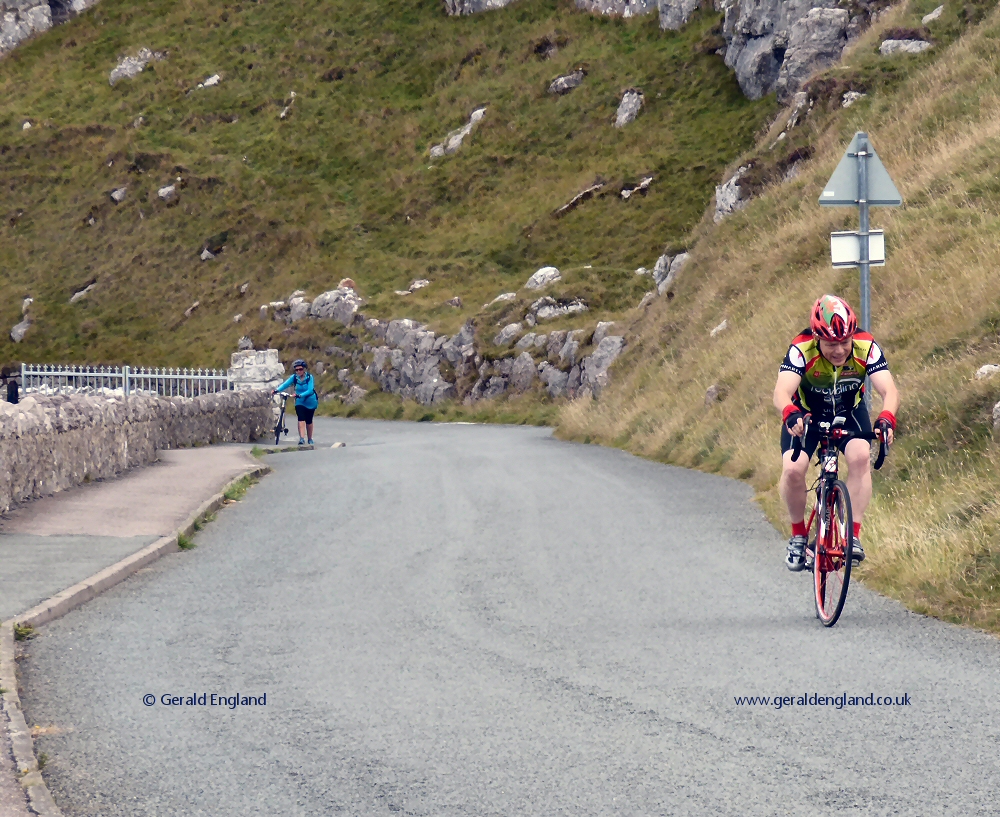
And finally a look at the road and two riders tackling the climb on their cycles.
A contribution to ABC Wednesday
and Wednesday Waters.
Subscribe to:
Posts (Atom)